Most people tested do not have cancer
Screening tests healthy people, and in any year only around one in a hundred people over fifty has an undiagnosed cancer. That simple fact dominates everything else.
Imagine testing 100,000 people, of whom about 1,000 have cancer. A test that catches 80% of cancers and wrongly flags 10% of healthy people finds 800 cancers and sends nearly 10,000 healthy people for scans and biopsies: fewer than one positive in thirteen is cancer (Derived). Raise specificity to 99.5% and the false alarms fall to about 500. This is why multi-cancer blood tests are designed for very high specificity, accepting that they will miss many early cancers, and why a single-cancer test with 90% specificity works only when the diagnostic pathway has demonstrated benefits that justify its costs and harms; colonoscopy is invasive and is not a cheap or risk-free follow-up.
Earlier diagnosis can lengthen measured survival without extending life
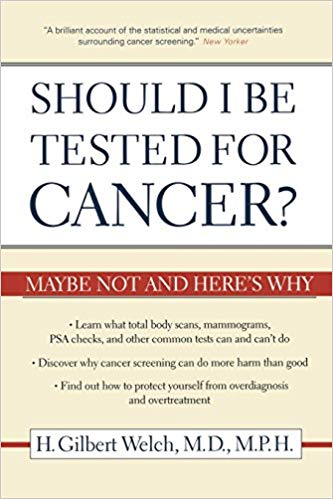
Imagine a cancer that would be diagnosed at 68 and cause death at 70. A blood test finds it at 63, but treatment changes nothing. Survival after diagnosis rises from two years to seven, even though the person dies at the same age. This is lead-time bias. Screening also preferentially finds slower-growing cancers, which remain detectable longer, and can identify cancers that would never cause illness. These effects explain why the dramatic survival gap between localized and metastatic cancer is a reason to investigate screening, rather than a measurement of its benefit. NCI’s explanation of screening statistics
The right comparison follows comparable groups invited to screening or usual care and counts cancer deaths, harms and resource use. A sustained reduction in advanced disease can be an earlier signal, but it does not automatically establish fewer deaths. The diagnostic pathway also belongs in the intervention: a positive blood signal needs a located tumour, a confirmed diagnosis and timely effective treatment. Without those steps, a technically accurate result can consume clinical capacity without improving outcomes. NHS-Galleri performance paper, September 2026
The age example is hypothetical. Screening benefit should be assessed against mortality and harms; five-year survival alone cannot establish it.
When a screening test says “cancer”, how often is it right?
In a population screen, almost everyone tested is healthy. Even a tiny false-alarm rate, applied to all of them, can outnumber the cancers found. Move specificity by a fraction of a percent and watch.
Per 100,000 people tested
- Cancers found
- 372
- Cancers missed
- 828
- False alarms needing follow-up
- 445
- Follow-up workups per cancer found
- 2.2
Presets are illustrative approximations. The multi-cancer case uses the specificity and all-cancer episode sensitivity reported for the NHS-Galleri trial; the single-cancer case is a generic 83%-sensitive, 90%-specific test, not a replication of Shield. Shield’s specificity is defined for people without advanced neoplasia, a different denominator from this model’s people without cancer. Real test performance differs by stage, cancer type and follow-up definition.
Calculation & assumptions
For 100,000 people: cancers present = prevalence × people; cancers found = cancers present × sensitivity; false alarms = people without cancer × (1 − specificity). Positive predictive value = cancers found ÷ all positive results. This is Bayes’ rule applied to a single screening round. It ignores repeat testing, how quickly a positive is resolved, the accuracy of the predicted organ of origin and overdiagnosis, the detection of cancers that would never have caused harm.
Detection is the first of six steps
A screening programme saves lives only if every step works: the signal, the test, the people tested, the follow-up, the treatment and the proof.
The tumour’s signal
Cancers shed DNA, proteins and cells into the blood, but small early tumours shed very little.
- Measure
- Tumour DNA per millilitre of blood by stage
- Failure boundary
- The cancers most worth catching early are the ones that leave the faintest trace.
Where the frontier moves
Reading several signals at once, such as DNA methylation patterns, fragment sizes and proteins.
The test
A screening test must catch cancers (sensitivity) while clearing healthy people correctly (specificity).
- Measure
- Sensitivity by stage · specificity · predicted organ of origin
- Failure boundary
- A false-alarm rate that looks tiny becomes thousands of unnecessary scans across a whole population.
Where the frontier moves
Multi-cancer blood tests with specificity above 99.5% and better sensitivity for early-stage disease.
Who gets tested
Screening works best in people at higher risk, where more of those tested actually have cancer.
- Measure
- Undiagnosed cancers per 1,000 people tested · uptake
- Failure boundary
- Testing low-risk people produces more false alarms per cancer found.
Where the frontier moves
Risk-based invitations using age, smoking history, family history and genetics.
Finding the tumour
A positive blood test must be followed by imaging and biopsy to locate and confirm the cancer.
- Measure
- Weeks from positive test to diagnosis · procedures per cancer found
- Failure boundary
- Diagnostic services already stretched by symptomatic patients can become a bottleneck.
Where the frontier moves
Tests that predict the organ of origin, which focuses follow-up on one part of the body.
Treating it early
The point of finding cancer early is that surgery or other treatment can then cure it.
- Measure
- Share of screen-detected cancers treated with curative intent
- Failure boundary
- Some early cancers are aggressive anyway; some would never have caused harm.
Where the frontier moves
Better ways to tell dangerous early cancers from harmless ones.
Proving it saves lives
Ultimately a screening programme is judged by whether fewer people die of cancer, not by how many cancers it finds.
- Measure
- Cancer deaths per 100,000 screened vs not screened
- Failure boundary
- Finding cancers earlier can make survival statistics look better without anyone living longer.
Where the frontier moves
Large randomised trials measuring late-stage incidence first and cancer deaths later.
More cancers found, earlier. Fewer deaths: not yet proven
Two large studies of the same multi-cancer blood test, Galleri, give the clearest picture of what the new technology can and cannot yet do.
NHS-Galleri, England, 2026
The test was positive in 0.91% of screening episodes, 52% of positives were confirmed cancers, and it correctly predicted the organ of origin 92.5% of the time. It caught about 55% of the 12 pre-specified deadly cancers and about 31% of all cancers. The growing stage IV reduction across rounds is encouraging, because screening benefits usually build as the backlog of prevalent cancers is cleared. But the trial was designed to show fewer late-stage cancers overall, and it did not. GRAIL reported a favorable FDA advisory-panel vote on 23 September 2026. That recommendation is separate from FDA approval and from proof of mortality benefit.
The screens that already work are underused
Proven screening saves lives now. Low-dose CT scanning of current and former heavy smokers cut lung-cancer deaths by 20–24% in two large trials. In 2024, between about 19% and 25% of eligible Americans were up to date with it, depending on the survey. Colorectal screening has also become easier: in July 2024 the FDA approved Guardant’s Shield, the first blood test cleared as a primary colorectal screening option, which detects 83% of colorectal cancers. A blood draw at a routine appointment may reach people who would never book a colonoscopy, provided those who test positive then get one.
Galleri’s mixed result is more informative than either headline
The NHS trial did not meet its primary goal of reducing combined stage III–IV diagnoses. GRAIL’s May presentation reported a 14% reduction in stage IV diagnoses of the 12 prespecified cancers overall, with larger reductions in later rounds. That secondary result is encouraging, but its inferential status and the failed primary endpoint belong in the same sentence. Cancer mortality follow-up remains necessary. Different screening rounds also represent different populations: the first searches an accumulated backlog, while subsequent rounds increasingly search for newly detectable disease. GRAIL’s May 2026 results factsheet
September’s peer-reviewed performance analysis puts numbers on that distinction. Positive predictive value fell from 58.0% in the first round to 50.4% and 45.8% in later rounds; all-cancer episode sensitivity ranged from 26.7% to 37.2%. These describe test performance, not a mortality benefit. A negative result therefore cannot exclude cancer or replace other screening. Meanwhile, the ACS estimates only one in five eligible Americans received lung screening in 2024. Expanding a proven programme offers a separate route to improvement while the multi-cancer evidence matures. Neal et al., Nature Medicine, September 2026; ACS’s 2024 lung-screening analysis
NHS-Galleri’s aggregate positivity denominator is screening episodes, not unique people. Advisory recommendations, regulatory authorization and proof of mortality benefit are separate milestones.
Use the screens we already have
Lung CT screening cuts lung-cancer deaths by a fifth to a quarter, yet only about one in five eligible Americans received it in 2024.
Guard specificity above all
In a population of mostly healthy people, every tenth of a percent of false positives matters more than a few points of sensitivity.
Test the people at highest risk
The same test is far more useful in a 70-year-old former smoker than in a healthy 40-year-old.
Build the diagnostic path first
A positive result is only useful if a scan and biopsy follow within weeks, not months.
Count deaths, not just detections
Stage shift is an early sign; fewer cancer deaths is the proof. Trials must run long enough to show it.
Respect overdiagnosis
South Korea’s thyroid cancer diagnoses rose about fifteenfold after widespread ultrasound screening, while deaths stayed flat. Finding more is not the same as helping more.
Who is building what
Blood-test developers, screening programmes and the trials that will decide whether new tests save lives. Search the record, or filter by role.
GRAILGalleriMulti-cancer detection from methylation patterns in cell-free DNA, with a predicted organ of origin
- Reported evidence
- PATHFINDER 2: 61.6% of positives were cancer at 99.6% specificity. NHS-Galleri: stage IV cancers down 14% across three rounds, but no reduction in combined stage III–IV.
- Announced next step
- FDA approval and evidence of fewer cancer deaths.
- Unresolved risk
- Low sensitivity for early-stage cancers; the primary endpoint of the largest trial was missed.
Guardant HealthShieldBlood test for colorectal cancer screening
- Reported evidence
- FDA approved in July 2024 as the first blood test for primary colorectal screening; 83% sensitivity for colorectal cancer.
- Announced next step
- Wider coverage and multi-cancer versions.
- Unresolved risk
- Lower detection of precancerous polyps than colonoscopy; positives must be followed by colonoscopy.
Exact SciencesCologuardHome stool DNA test for colorectal cancer
- Reported evidence
- FDA approved since 2014 and widely used, with an updated version approved in 2024.
- Announced next step
- Higher screening uptake among people who avoid colonoscopy.
- Unresolved risk
- False positives and the need for follow-up colonoscopy.
FreenomeBlood-based colorectal testMachine learning across several blood signals for colorectal cancer
- Reported evidence
- Evaluated in the large PREEMPT CRC validation study.
- Announced next step
- Regulatory approval and multi-cancer expansion.
- Unresolved risk
- Competing tests and modest detection of precancerous lesions.
NHS EnglandLung cancer screeningInvited low-dose CT screening for current and former smokers aged 55–74
- Reported evidence
- Grew from Targeted Lung Health Check pilots that found most cancers at an early stage.
- Announced next step
- Full national coverage by around 2030.
- Unresolved risk
- Radiology capacity and reaching people least likely to attend.
U.S. Preventive Services Task ForceLung screening recommendationAnnual low-dose CT for adults 50–80 with a 20 pack-year smoking history
- Reported evidence
- Recommendation expanded in 2021; uptake among eligible adults remained around one in five in 2024.
- Announced next step
- Higher uptake through primary care and outreach.
- Unresolved risk
- Eligibility is hard to identify from records; access gaps in rural areas.
National Cancer InstituteVanguard StudyA feasibility study of multi-cancer detection tests within the Cancer Screening Research Network
- Reported evidence
- Launched in 2025 to test how MCED tests can be studied in a large randomised trial.
- Announced next step
- A definitive trial of whether MCED screening reduces cancer deaths.
- Unresolved risk
- A mortality trial would take many years and very large numbers.
NHS-Galleri investigatorsLong-term follow-upContinued follow-up of 142,250 participants for late-stage incidence and mortality
- Reported evidence
- Full results presented in 2026 showed a growing stage IV reduction across rounds.
- Announced next step
- Evidence on cancer deaths.
- Unresolved risk
- Results may not translate to other health systems or test versions.
Sensitivity figures depend heavily on cancer stage and type. A test’s value is judged by stage shift first and, ultimately, by fewer cancer deaths in randomised trials.
An optimistic view, with conditions
Screening for most cancers is becoming technically possible
For the first time, a single blood test can detect dozens of cancer types, including many with no screening option, at approximately 99.5–99.6% specificity in the reported studies. If repeated screening keeps cutting stage IV diagnoses, and proven screens like lung CT reach the people eligible for them, many more cancers will be caught while they are still curable.
Use proven screens fully
Raise lung, colorectal, breast and cervical screening uptake, with blood tests to reach people who avoid other options.
Stage shift that lasts
Multi-cancer tests must keep reducing late-stage cancers across repeated rounds, in more populations, with fast diagnostic follow-up.
Cancer as a routine finding
Annual blood tests find most cancers while small and treatable, and fewer people die of cancers that were silent until too late.
Four numbers to watch
First, cancer deaths in the long-term follow-up of NHS-Galleri and similar randomised trials. Second, the stage IV reduction across successive screening rounds. Third, uptake of proven screening, especially lung CT among eligible smokers. Fourth, the specificity of blood tests in routine use, outside the controlled conditions of trials.
Sources, method, and boundaries
Survival figures are SEER data reported by the American Cancer Society. Test performance now includes peer-reviewed NHS-Galleri and PATHFINDER 2 papers published on 22 September 2026. Stage-shift results here are attributed to the May 2026 presentation; they do not establish a mortality benefit. The interactive model is a single-round application of Bayes’ rule and does not account for repeat screening, overdiagnosis or follow-up capacity.
- Sensitivity
- The share of people with cancer whom a test correctly flags.
- Specificity
- The share of people without cancer whom a test correctly clears.
- Overdiagnosis
- Diagnosing a cancer that would never have caused symptoms or death in the person’s lifetime.
Read More
Essays, books, talks, and research that shaped this field’s arguments. Influence is not endorsement; company communications and advocacy are labeled. Some publisher links require a subscription.
- Paper
National Lung Screening Trial Research Team — Reduced lung-cancer mortality with low-dose CT screening (NEJM, 2011)
The trial that established lung screening’s 20% reduction in lung-cancer deaths.
- Paper
de Koning et al. — Reduced lung-cancer mortality with volume CT screening in a randomized trial (NEJM, 2020)
The European NELSON trial’s confirmation of lung screening benefits.
- Company communication
GRAIL — Full results from the NHS-Galleri trial (2026)
The largest randomised trial of multi-cancer blood testing; read with its missed primary endpoint in mind.
- Essay
ASCO Post — South Korean study sparks warnings about the hazards of overscreening
The thyroid cancer case that shows why finding more cancer is not always better.
Across the fields: learning curves, deployment, and rebound
- Theodore Wright — Factors Affecting the Cost of Airplanes (1936)
The original experience-curve formulation: costs change with accumulated production.
- Kenneth Arrow — The Economic Implications of Learning by Doing (1962)
The economics of productivity improvement through production experience.
- William Stanley Jevons — The Coal Question (1865)
The classic rebound argument: lower effective costs can expand total demand.
- Arnulf Grübler — The costs of the French nuclear scale-up: A case of negative learning by doing (2010)
A counterexample to assuming that greater deployment always lowers costs.